


Memory on the iPhone
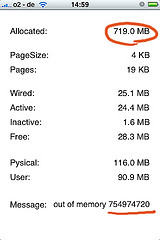 Now here is the question: How much memory does the iPhone have? How much memory is OK for applications to
use? Curious as I am I did some research and wrote a little test project. This got me some odd results.
Now here is the question: How much memory does the iPhone have? How much memory is OK for applications to
use? Curious as I am I did some research and wrote a little test project. This got me some odd results.
According to what you find on the net the iPhone has a total memory size of 128 MB and your application should not use more than 46MB of it. But what happens exactly when you try to obtain more?
So I wrote a little application that continuously allocates more and more memory. In fact it mallocs/frees the memory on every timer tick.
Now this is where it gets odd. While the sysctl() calls do report something around 128MB of RAM I can malloc() way beyond this. In fact calling malloc(700000000) does not fail at all! When I run the application on just the iPhone it will stop at around 719MB. When I run it through Instruments the whole devices freezes at around 46MB. This has been reproduced on 2.1 and 2.2 on different devices.
- (void)tick
{
    allocated = allocated + size;

    if (allocatedPtr) {
        free(allocatedPtr);
    }

    allocatedPtr = malloc(allocated);

    if (!allocatedPtr) {
        NSLog(@"out of memory at %ld", allocated);
    ...
Later I found someone who stumbled across the same thing.
Lazyweb: what is going on here?
You can download the test application here. But as a disclaimer: you run this code on your own risk!
Update:
So afterall this means the result of malloc() has a different semantic of what I expected. Adding the following piece of code makes the program behave and gives the expected
result.
    long *p = (long*)allocatedPtr;
    long count = allocated / sizeof(long);
    long i;
    for (i=0;i<count;i++) {
        *p++ = 0x12345678;
    }
So it turns out if you allocate (and use!) around 46-50 MB in your iPhone application it will just get terminated.
Vas the Man